
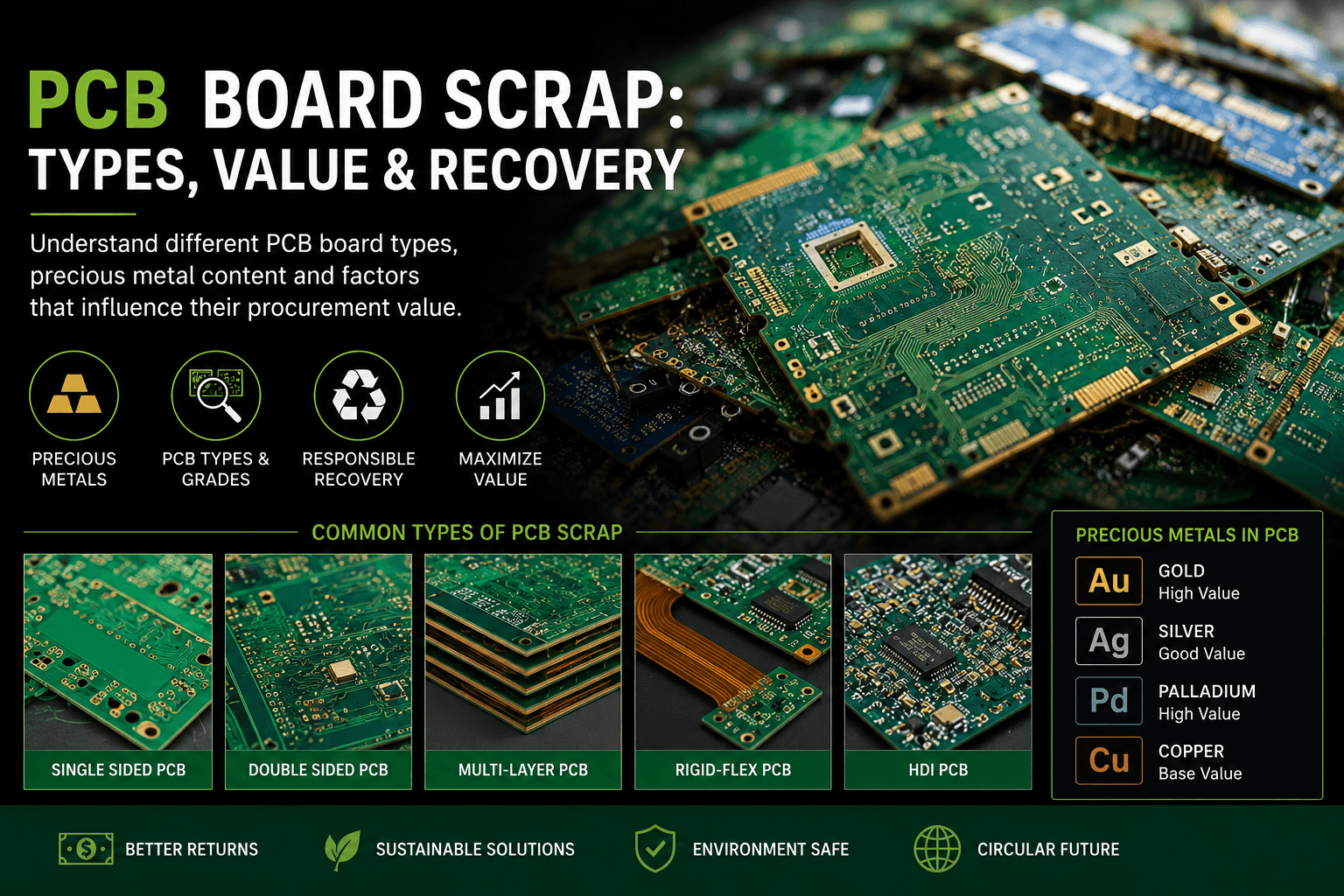
Printed circuit boards are among the most recognizable forms of electronic scrap. They are found inside computers, servers, networking equipment, industrial controllers, telecom systems and many other electronic products.
But PCB scrap is not one uniform material. Boards can differ substantially in construction, component density, application, condition and recoverable material. That is why a useful procurement process starts with identification and segregation rather than treating every board at one rate.
What is PCB board scrap?
PCB stands for Printed Circuit Board. A PCB provides the electrical and mechanical platform on which electronic components are mounted and interconnected.
When equipment becomes obsolete, damaged or surplus, its circuit boards may become part of an electronic scrap lot.
Common sources include:
- Desktop and laptop computers
- Servers and workstations
- Routers and network switches
- Telecom equipment
- Industrial control systems
- PLC and HMI equipment
- Power supplies
- Consumer electronics
- Communication equipment
Common PCB categories found in scrap
A procurement lot may contain several board categories.
Computer and server boards
Motherboards and server boards can contain processors, memory interfaces, connectors and other components.
Networking and telecom boards
Routers, switches, telecom cards and communication equipment can contain complex multi-layer boards and a variety of components.
Industrial PC and controller boards
Industrial systems may contain specialized control boards, I/O modules and interface cards.
Mobile and small-device boards
Mobile phones and compact electronics contain smaller, densely populated boards.
The exact classification should be based on the actual material rather than assumptions from appearance alone.
What affects PCB scrap value?
Board type and origin
The equipment from which a board comes can provide useful information about its construction and components.
Component density
Board design and component concentration can affect material recovery potential.
Condition
Damaged, contaminated or incomplete boards may be evaluated differently from clean, intact boards.
Quantity
A larger, consistently sorted lot can be easier to inspect than a small mixed lot.
Recoverable materials
Some PCBs and components contain copper and other metals, and certain components or plated areas may contain precious metals in small quantities. This does not mean the board contains a predictable amount of gold or other precious metal.
Gold fingers are not solid gold
Computer and electronic boards may have gold-plated contact areas, commonly called gold fingers. The gold layer is extremely thin.
Therefore, a board should not be valued simply by looking at the color of its contacts. Recovery depends on the actual material, quantity and downstream processing economics.
Should businesses remove components from PCBs?
Not necessarily.
Uncontrolled dismantling can damage boards and create additional mixed material. For a commercial lot, it is often better to document and segregate the boards first and discuss the appropriate preparation with the procurement or recycling channel.
How to prepare PCB scrap for procurement
A practical preparation process is:
- Keep PCB boards separate from general metal and plastic scrap.
- Group visibly different board categories where practical.
- Remove obvious non-PCB packaging material.
- Record approximate weight.
- Photograph representative boards.
- Keep the material dry and protected from unnecessary contamination.
Example procurement information
When requesting an evaluation, provide:
- PCB type or source equipment
- Approximate weight
- Quantity if countable
- Photographs
- Location
- Whether boards are complete or already dismantled
This gives the buyer a much better basis for an initial assessment.
PCB scrap and responsible recycling
PCB processing should be handled through appropriate recycling channels because circuit boards contain a mixture of metals, plastics, fiberglass and electronic components.
At NextGen, our role is focused on procurement and asset recovery. Non-reusable material is responsibly channelized to authorized recycling partners rather than being presented as if NextGen itself were the final recycling plant.
Final takeaway
PCB scrap value is driven by what the board actually is, not simply by the fact that it is a circuit board.
Identify the source, separate the material, document the quantity and condition, and allow the actual lot to be evaluated.
Have PCB boards available in bulk? Share photographs, approximate weight and location with NextGen E-Waste Solutions for procurement evaluation.