
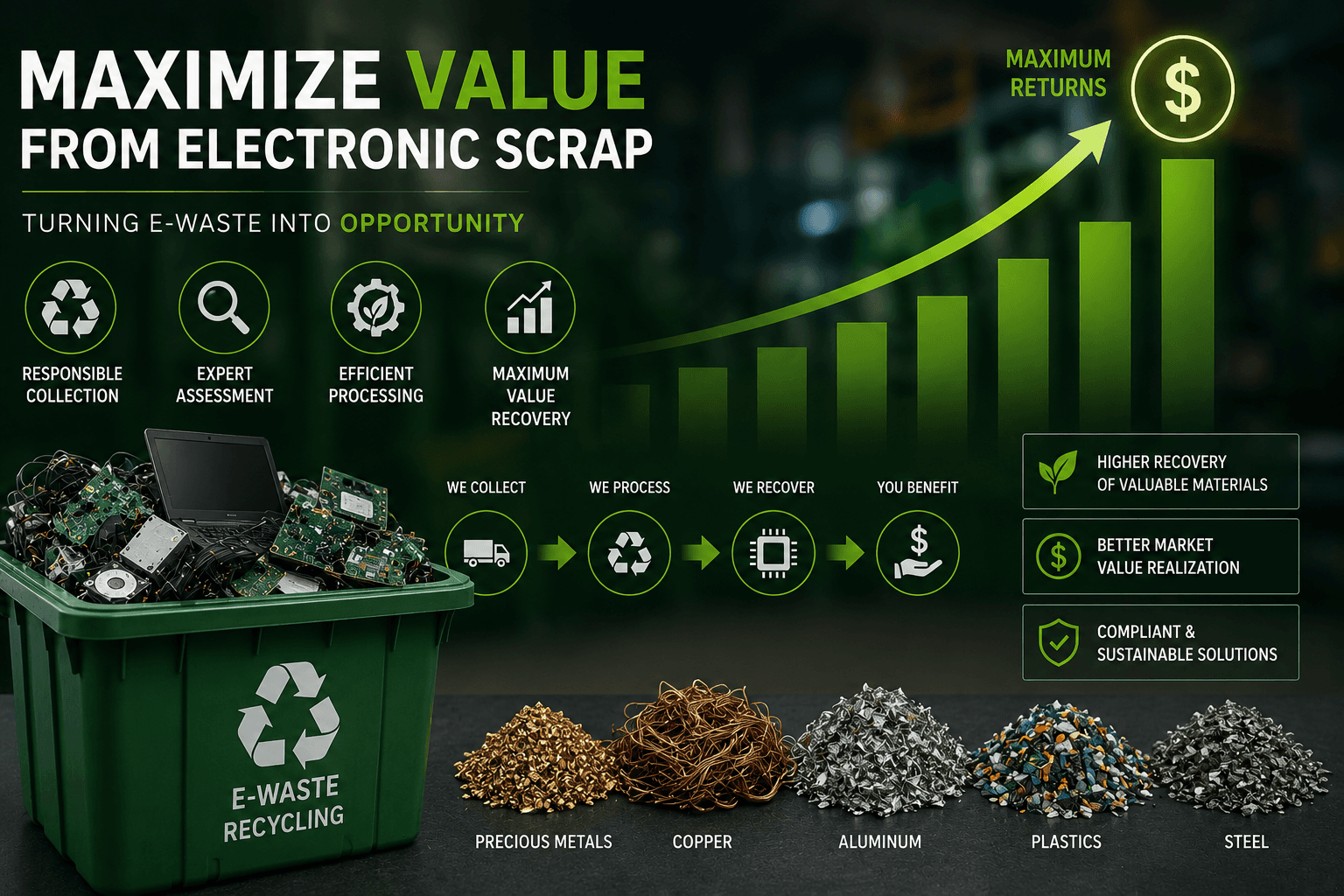
When businesses have a large quantity of electronic scrap, the first question is often: What is it worth?
There is no single price for electronic scrap. Value can depend on material type, grade, quantity, condition, recoverable components and the route available for the material.
The good news is that businesses can make the procurement process easier—and sometimes improve the value they recover—by preparing the material properly.
1. Don't mix every material together
A box containing PCB boards, copper cable, batteries, routers and broken computer cases is difficult to evaluate accurately.
Separate major categories where practical:
- PCB boards
- IT equipment
- Networking equipment
- Copper cable and wire
- Batteries
- Industrial electronics
- Electronic components
The objective is not to perform complex dismantling. It is simply to make the lot understandable.
2. Keep potentially reusable equipment complete
A working laptop can have a different recovery route from a non-working laptop. The same applies to servers, switches, routers, monitors and industrial electronics.
Avoid dismantling complete equipment simply because it is old. Let the equipment be evaluated first when practical.
3. Record quantity and approximate weight
Quantity matters, but weight can also be important for material-based scrap.
For a procurement enquiry, record:
- Number of pieces
- Approximate total weight
- Equipment type
- Working/non-working condition
- Location
If the lot contains several categories, record them separately.
4. Take clear photographs
Good photographs can save time during the initial quotation process.
Take wide photographs showing the overall lot and close-up photographs of labels, PCB boards, connectors or unusual equipment where relevant.
Don't photograph only the best-looking items. The goal is to represent the actual lot accurately.
5. Preserve labels and model information
Model numbers and equipment labels can help identify what an item is and whether it may have reuse value.
This is particularly useful for industrial electronics, servers, networking equipment, PLC modules, drives and specialized control equipment.
6. Don't assume precious-metal content equals high value
Electronic equipment can contain small amounts of valuable metals, but the actual recoverable value depends on the material, concentration, quantity and downstream processing.
A gold-plated connector, for example, should not automatically be valued as if it were solid gold.
7. Handle batteries separately
Lithium-ion and other batteries should be kept identifiable and handled carefully. Damaged or swollen batteries require additional safety precautions and should not be mixed casually with general scrap.
8. Keep a basic material sheet
A simple table can make a procurement enquiry much more efficient:
| Category | Quantity | Approx. weight | Condition |
|---|---|---|---|
| Laptops | 20 | — | Mixed |
| PCB boards | — | 35 kg | Scrap |
| Copper cable | — | 80 kg | Scrap |
| Network switches | 12 | — | Mixed |
The exact valuation should be determined after reviewing the actual material and applicable market conditions.
What actually influences electronic scrap value?
Several factors can affect a lot's value:
Material composition
Different electronic materials contain different recoverable components and metals.
Grade and category
PCB boards are not one uniform material. Equipment origin, board construction and component density can influence evaluation.
Condition
Working or repairable equipment may have reuse value beyond material value.
Quantity
Larger, well-organized lots can be easier to inspect and process than small mixed lots.
Market conditions
Commodity and recovered-material markets change. A historical quotation should not be treated as today's market price.
The biggest mistake: optimizing for a price before identifying the material
Businesses sometimes ask for a rate before providing a clear description of the lot. That can lead to unrealistic expectations.
A better approach is:
Identify → Separate → Document → Inspect → Evaluate → Quote
This creates a more transparent procurement conversation.
How NextGen evaluates procurement enquiries
At NextGen E-Waste Solutions, we focus on bulk industrial electronic scrap and surplus electronic assets. Material details, photographs, quantities and condition help us understand the lot before collection and inspection.
Where equipment is suitable for recovery, it may be considered for refurbishment or resale. Non-reusable material is responsibly forwarded to authorized recycling partners.
Final takeaway
You cannot control every factor affecting electronic scrap prices, but you can control how well the material is prepared.
Clear segregation, accurate information, preserved equipment condition and realistic expectations create a stronger foundation for procurement evaluation.